
Family Boards: How to Make Them Work

Developing and implementing a Family Board is a useful way to organize the various challenges and stakeholder interests in a Family Business to maximize its success. Each Board group is clearly identified in terms of its authority, role and responsibility. The interfaces of each group are defined to enhance good family relations and reduce boundary confusions. Importantly, the focus is of the family shifting to more rational from emotional ways of relating. The planning process is used as the foundation to maximize the success of the business and to provide an objective basis for communication. problem solving and decision making.
Introduction
One of the fundamental reasons families in business together have difficulty getting organized and resolving conflict is that they do not have the necessary “tools” with which to work.
These tools are structures, procedures, and skills that would help sort through the problems and conflicts that must be resolved for the family business to achieve success. The development and implementation of a Family Board have emerged as a useful way to teach families how to use these tools to be more successful.
The purpose of this article is not to plow new conceptual ground. but rather to draw together practice points, ideas, and principles and integrate them into a cohesive vehicle that may be used to work with families. The essay is divided into several sections. First, an outline of the assumptions and contextual background for this approach is presented. Second, the structure of the various entities associated with a Family Board is detailed. Next, the implementation process is described, followed by an overview of how a Family Board would typically function.
Assumptions
The beginning point is that we are working at the intersection of the family and business systems. We are trying to help the family learn to make good business decisions and maximize relationships among family members.
A systems approach is adopted that identifies the “client” as all the stakeholders in the various sub-systems. This includes owners, family members, and non-family employees as well as the various intersections of each group.
Our over-arching goal is to maximize it working for everyone. The minimal goal for the family is to develop their skills to the point they can work together to run the business. Our minimal goal for the business is for everyone to make a good living. This approach adopts a facilitative/coaching model of consultation. The charge to the consultant is to get the groups from “Point A” to “Point B” to “Point C”. As others have stressed. long term success will be accomplished by achieving a balance among three competing needs:
- The capital needs of the business.
- The liquidity needs of the family to meet financial demands.
- The needs of the family to have ownership control of the business.
Another assumption is that focusing on a rational and objective way of relating as promoted in solving business problems is a good strategy to refocus the subjective and emotional energies of the family. Process and relationship issues are dealt with as needed. Lastly, to be successful, the family needs to commit to a developmental process of unlearning old ways and developing new skills. It is not a quick fix.
Purposes of The Family Board
The list of purposes is lengthy and indicates the number and diversity of agendas that potentially can be accomplished. All these purposes are integrated and cumulate to achieve the desired results.
The specific purposes of a Family Board are:
- To provide a way to achieve appropriate participation by all stakeholders. Consistent with our overall assumption. our goal is to derive structures and procedures that bring all the constituent groups into the loop in a way that works and makes sense.
- To provide a way to balance power among the various systems. The power is invested in the Board as an institution rather than an individual. A transcendent function is achieved that goes beyond anyone person. Decision making based on consensus rather than power is promoted. A forum is provided for individuals to learn more positive ways to relate to one another instead of relating based upon power. Open and constructive communication, problem solving, and decision making is fostered. Working together in a Family Board format can be the basis for team building among family members.
- The structures and procedures of the Board form the basis of rational and objective decision making rather than emotional and subjective processes.
- The Board represents a stable structure in times of crises.
- Forming the Board can be a “fresh start” and a new foundation for going forward for the group. The past can be put in the past.
- It can provide the structure for the further transition of the business to future generations.
- Implementing a Board is a good step towards depersonalizing the formula for success for the business and institutionalizing it. It provides an opportunity for Founders to share their dreams with all who will come after them.
- The overlap between the family and the business is organized. And a differential focus on family and business issues is fostered.
- The family is encouraged to focus on business issues and what is required to maximize the business.
- An effective way is provided to organize the ownership/management interfaces in the business. Boundary confusions that typically exist for family member owners who are also employees of the business are reduced.
- A forum maybe provided for input from knowledgeable people outside the family and the business.
Family Board Structure
The term “Family Board” is a simplified representation of not only a single entity but of a more elaborate set of structures and procedures typically referred to as the “Family Governance Structure”.
The concept of the Board is emphasized here because more people are familiar with it and it is central in importance. The primary focus will be on a smaller business where the Family Board functions as a Board of Directors. In a larger business with professional managers an active Board of Directors would be positioned below the Family Board in a hierarchical organizational chart. The organization of the various groups in terms of the roles. responsibilities and authority of each. It demonstrates boundaries and the relationship of each group to the others.
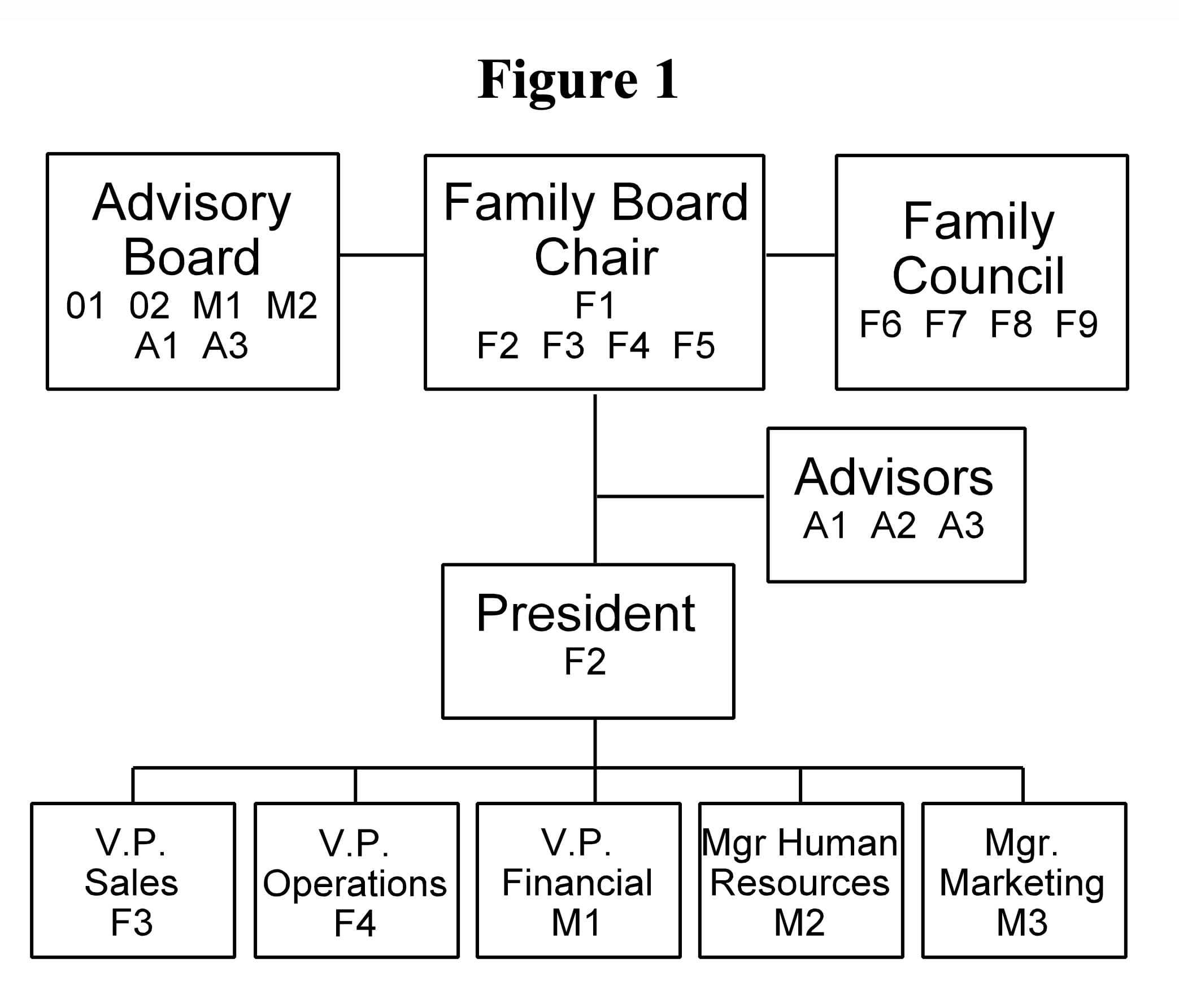
It does not suggest that each group meets separately. The Advisory Board probably would meet only in conjunction with a Family Board meeting. It does show that the decision-making power rests solely with the Family Board the ownership group. It is a generic structure as it may not always be possible to put in place each component in every client situation for various reasons. In some cases, it may not be feasible to bring other family member stakeholders into the process. Alternatively, some families are highly resistant to outsiders being involved in the business in any way. This structure is a goal and a conceptual framework for moving forward.
The Family Board
The Family Board is composed of family members who have an ownership interest in the company.
It is chaired by “F1” who is a family member who does not work in the business, but who owns stock-perhaps the retired founder. “F2” is a family member who sits on the Board, owns stock and is also President of the company. “F3” is the VP of Sales, owns stock and is a Board member. “F4” is a family member who is VP of Operations and who owns stock. “F5” does not work for the business but owns stock and has a position on the Board. This person might represent a minority shareholder. The power to make decisions and run the business rests squarely with this group. This organization provides a clear boundary between family members as owners with Board rights and responsibilities and family members as employees of the organization. The specific roles and responsibilities of the Board are to:
- Have ultimate responsibility for the success of the family working together as a team, the success of the business and the family running the business.
- Be responsible for and monitor the progress of the organization.
- Provide an overall vision for the company.
- Be the steward of the family assets.
- Be ultimately responsible for family personnel decisions, including hiring, firing, discipline, and compensation.
- Insure proper succession planning.
- Determine the degree to which the family wants to be cohesive.
The Advisory Board
The Advisory Board is made up of outsiders, “01” and “02”, as well as the Manager of Human Resources (“M2”) and the VP of Finance (“M1”). Two advisors to the company are included on this Board whereas a third (“A2”) is not.
The specific responsibilities of the Advisory Board are to:
- Act as a sounding board for the family.
- Provide outside perspective.
- Be a stabilizing influence in a time of crisis.
The Family Council
The Family Council is composed of family members who do not own stock or work in the business.
Most likely they would be spouses and children of family member owners. Again, a clear boundary is drawn between the ownership group and other constituencies while still providing a forum for input. Specific responsibilities of the Family Council are to:
- Be informed as to the status of the business.
- Provide input on decisions.
- Provide support.
As noted earlier, this structure does not suggest several different groups all having multiple meetings. Often the Family Board and the Advisory Board would meet jointly to discuss long range policy and strategy. Members of all four groups might meet to celebrate the business in an annual meeting format.
Implementation
In order to get organized and begin the process, the Board would develop:
- A Family Mission Statement.
- A statement of scope and purpose of the Board.
- A statement of roles and responsibilities for each of group.
- Ground rules, developmental goals, and working understandings for the Board.
- A Mission Statement, Strategic Plan. and Business Plan for the business.
- Procedures for regularly monitoring the progress of the business and the family-the planning process.
- An action plan for the necessary legal and financial requirements.
- Income distribution and family employment policies.
- A committee structure for running itself.
The process of the family developing these procedures and documents begins the accomplishment of several of the purposes discussed above. The experience should shift from one of frustration over being “stuck” to more positive feelings based on success and accomplishing goals through teamwork. Setbacks and rough going especially in the beginning are inevitable. The key is to be persistent with the positive focus and to trust the process. It may be anticipated that this development will require twelve to eighteen months.
Functioning
Initially, the Board would meet on a frequent basis (biweekly or monthly) to establish momentum, take advantage of the initial energy and get organized.
Meetings would be spent developing the various documents and would follow a format of individuals being assigned “to do lists” and bringing back the results for consideration and review by the whole Board. One goal in the early stages is for the group to experience success working together around positive goals and to begin to define working relationships based upon performing a specific task as a member of a team. After a while this process is expanded and formalized into what is the heart of making the Family Board successful The Planning Process.
A formal planning process is used in most professionally managed companies, but not often in family businesses. It may take many different forms, but the one that seems to work well in a family business. It may take many different forms, but the one that seems to work well in a family business is presented in Figure 2.

The Mission Statement represents the broadest statement of the overall direction of the business. It is followed by a statement of strategy and long range plans. Next, the game plan for the coming year is developed. This game plan is composed of financial, performance and special project goals and objectives. The plan is divided up and allocated to the units of the business that will be responsible for its accomplishment.
This process is pushed as far down into the organization as possible. The goal is for each business unit to have its own business plan that is integrated into the plan. These plans are implemented and reviewed monthly or quarterly. Once a year, the entire process is recycled by reviewing the Mission Statement and Strategy, rolling over the long range plan, and establishing the new game plans for the next year.
This planning process achieves several important goals. It helps define the relationship of the family member who works for the company, especially the President, with his employers the Board. It increases the accountability of family member employees. The development of the plan is a collaborative process, but once having been put in place, it is his or hers to achieve. If progress is satisfactory then the role of the Board is to consult and advise. Should substantial plan deviations occur, then it is the Board’s responsibility to become more involved and remediate the situation.
This process communicates the direction of the company to all the stakeholders. It also provides the basis for establishing a compensation system based upon business success rather than more subjective criteria. This goal directed approach is good for the business, and it gets the family to define the strategic niche of the business. The plan helps to focus the family on making the business successful and gives them a specific road map for achieving it.
The Board would also develop a planning calendar to include an annual retreat and a planning sequence tied to the fiscal year. Regular meetings would be scheduled to assess progress of the business and the family toward the previously developed action and business plans. One possible scenario would be for the Board to meet monthly, to have joint meetings with the Advisory Council quarterly and have twice a year meeting with the Family Council. This last meeting might be tied to a year-end review and projections of goals for the coming year.
The pitfalls to the success of a Family Board are someone not willing to be a team member or an irreversible downturn in the business. Most other challenges including deaths and divorces can be worked through. In fact, the value of the Board is most clearly demonstrated during such crises.


